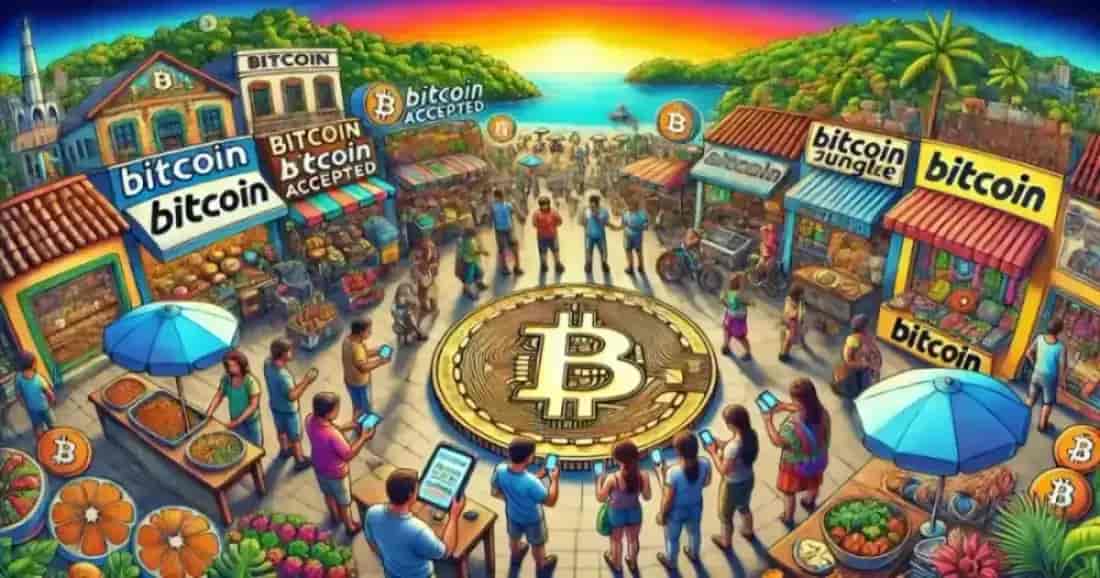
Bitcoin Circular Economies: Real Business Adoption
February 26, 2025

Rodrigo Fernández
Director of Infrastructure
A Bitcoin circular economy develops when people receive bitcoin and can spend some of it again with other participants. Accepting a payment is one step; having useful places to spend it is what extends the cycle.
A community does not need to transact exclusively in bitcoin to explore this model. Merchants may still pay expenses in local currency, and each business needs its own payment and accounting process.
Three community projects to study
These projects offer starting points for understanding local adoption:
Bitcoin Jungle (Costa Rica) uses a community Lightning wallet (a Galoy fork) and BTCPay POS terminals. When an invoice is paid, the integration forwards the received bitcoin to the merchant's wallet using LNURL. On-chain payments are also accepted so visitors without Lightning can still pay.
Merchants can use Bull Bitcoin inside the wallet to buy or sell bitcoin for Costa Rican colones via SINPE Móvil, providing an off-ramp to meet local expenses without requiring every participant to hold bitcoin indefinitely.
The project maintains a public merchant map concentrated in the Bahía Ballena area (Dominical, Uvita, Ojochal) and has hosted events such as Nostrica in Uvita using the local merchant Lightning network. A 2023 BTCPay case study reported approximately 200 stores and 5,000 invoices on one BTCPay instance as of that write-up.
Bitcoin Beach (El Salvador, El Zonte) started as a community project where bitcoin donations remained in bitcoin as stipends for youth programs such as beach cleanup and lifeguard training. Locals download a Lightning wallet (Bitcoin Beach Wallet, later part of the Blink/Galoy lineage) and pay merchants by QR over Lightning.
The project page states locals can pay utilities (phone, water, electric), medical care, food, and haircuts in bitcoin. Strike plus Lightning provided a remittance path that could land value locally at lower cost than traditional cash-out lines.
A CoinDesk report from April 2023 (updated September 2023) described approximately 3,000 users, 500+ families, and ~120 businesses at that time. The project also runs a Fellowship Program hosting leaders from other circular economies for hands-on merchant onboarding and education immersion.
Praia Bitcoin (Brazil, Jericoacoara) began in September 2021 as a local experiment using Lightning micropayments, local nodes, and Bolt Cards so shops and workers could accept small bitcoin spends.
The project rolled out payment systems to 21 establishments by early 2023 and ran school programs such as "Fruits for SATs" where students and teachers used Bolt Cards and local POS for sats-priced fruit purchases (the project claims approximately 6,000 fruits at 10 sats each in December 2022).
In February 2026, the project announced the end of operations and that its community center would close by April 2026, with its sites kept as a historical record. Praia Bitcoin offers a study example of a prior circular experiment rather than a currently expanding economy.
A project name or merchant listing does not prove current transaction volume, profitability or financial self-sufficiency. Verify whether a particular merchant still accepts payments and which payment method it supports.
What makes participation useful
A payment option becomes practical when staff can explain it, confirm receipt and handle exceptions.
For a merchant, useful questions include:
- Do customers ask to pay in bitcoin?
- Can staff distinguish an on-chain payment from a Lightning invoice?
- Who controls the receiving account or keys?
- How are refunds and unsuccessful payments handled?
- Can received funds meet an actual business expense, or is conversion needed?
Lightning can support fast payments, but routing, liquidity and the chosen service affect the experience. A failed attempt is an operational issue to resolve, not evidence that a customer has paid.
Keep custody and operating costs visible
A custodial service holds funds on your behalf. Self-custody gives you responsibility for keys and recovery. Neither should be selected solely because setup looks easy.
Count the costs of processing, network activity, conversion, equipment and staff time. A missing card-style chargeback mechanism does not remove refund obligations, theft risk or accounting work.
Set a business policy for payment records and conversion. Participation in a circular economy does not require a speculative treasury strategy.
Test before expanding
Test your payment setup with real transactions, document custody and recovery procedures, and train staff before expanding. Operational details such as choosing a custody option, handling on-chain versus Lightning payments, testing refunds, and planning pilot rollouts are covered in Accepting Bitcoin payments online.
If you operate your own node, follow its implementation-specific backup procedure. A generic server snapshot should not be assumed to recover Lightning channels safely.
Frequently asked questions
Must every transaction use bitcoin?
No. Circular use can coexist with other payment methods.
Does accepting bitcoin guarantee more sales?
No. Measure actual demand and repeat use rather than assuming a listing will generate revenue.
Must a merchant run a server?
No. Hosted services and self-managed systems have different custody and operating responsibilities. Choose deliberately.
Begin with a process you can maintain
Start with a tested payment flow and a clear owner for day-to-day operation. Expand only when staff and customers can use it reliably.
Related reading
- Accepting Bitcoin payments online covers integration and payment checks.
- CR Servers' Bitcoin adoption history separates the documented milestone from operating lessons.